
518-727-5458 joelle@joellelydon.com

Why self-regulation is one of the most important relationship skills you can build

Years ago, I watched My Big Fat Greek Wedding—a film I have returned to many times since. There is a line in it that has stayed with me, one I often share with clients.

When Toula is struggling with her father, her mother Maria offers this bit of wisdom: “The man is the head, but the woman is the neck. And she can turn the head any way she wants.”

At the time, I took it as the funny, culturally loaded line it was meant to be. But over the years, I have come to hear something else in it.   Not that one person should control another, but that, in a relationship, the person who can see the clearest path forward often has the greatest ability to influence what happens next.

And in my experience, that clarity is rarely about who is smarter, more persuasive, or more “right.”  It is more about who is most regulated.

Being regulated means you have greater access to perspective. That you can often see beyond the immediate hurt, fear, anger, or misunderstanding. That you are more able to pause before reacting, to stay connected to yourself, and to remember what matters most.

This does not make you superior. Nor does it mean you carry the entire relationship. It simply means you may be the person with enough internal steadiness, in that moment, to help create a different path forward.

That is why I believe your nervous system is in the relationship too.

There is you. There is the other person. And there are the nervous systems both of you bring into every conversation, disagreement, disappointment, rupture, repair, and moment of connection.

The Part of You That’s Always Listening

Everywhere we look, there’s a great deal of conversation today about nervous system regulation. And for good reason. Yet it can sometimes feel overly scientific, overly clinical, or disconnected from the ordinary moments where relationships actually unfold.

At its most basic, your nervous system is your body’s command center and communication network. It is constantly taking in information from the world around you and from within you. It helps determine whether you feel safe, threatened, connected, overwhelmed, calm, alert, shut down, or ready to act.

It influences your breathing, your sleep, your memory, your capacity to focus, and your emotional responses. It is always listening for cues: the tone in someone’s voice, the pause before they respond, the look on their face, the text that goes unanswered, the familiar feeling that tells you something is wrong.

And when it perceives threat, it moves quickly before you have had time to think.

That is why you can know you do not want to react in a certain way and still find yourself reacting. You can understand that a conversation is not really about the dishes, the vacation, the money, or the missed phone call—and still feel yourself becoming defensive, shutting down, over-explaining, criticizing, or trying desperately to make the discomfort stop.

The good news is that your nervous system is adaptive.

You are not trapped by the baseline you were born with or the patterns you learned in earlier relationships. You are not destined to repeat the same reactions for the rest of your life. Your nervous system can learn new ways of responding. It can become more resilient, develop greater capacity for staying present when life becomes difficult.

And that changes everything.

When Protection Takes Over

Most people do not recognize dysregulation when it is happening. They simply think, “This is how I feel,” or “This is what they made me do.”

But dysregulation can look very familiar. It can look like:

  • emotions that go from zero to one hundred in a matter of seconds.
  • replaying a conversation in your mind long after it is over,
  • trying to find the moment where everything went wrong.
  • making a decision quickly because sitting with uncertainty feels unbearable.
  • withdrawing from someone you love because closeness suddenly feels too vulnerable.
  • becoming intensely focused on getting reassurance, agreement, or resolution right now.
  • losing trust in yourself because your feelings feel so large that you no longer know which part of you to believe.

In relationships, dysregulation may show up as explosive reactions, emotional distance, silent treatment, criticism, defensiveness, blame, people-pleasing, or the exhausting experience of walking on eggshells around one another.

Many people assume these are communication problems.

Often, they are nervous system problems first.

This does not excuse harmful behavior. We are still responsible for how we treat one another. But it does help us understand why good intentions can disappear so quickly when we feel threatened.

When the nervous system is activated, we are often no longer operating from our deepest values. We are operating from protection.

Why Knowing Better Is Not Always Enough

One of the most common things I hear from clients is, “I know better, but I still do the same thing.”

That sentence holds so much tenderness.

Because it is not usually a lack of intelligence, awareness, or desire that keeps someone repeating an old pattern. Most people already know what they wish they could do differently. They have read the books. They have listened to the podcasts. They have had the conversations with friends. They may even have been in therapy or coaching before.

And yet, when the charged moment arrives, the old response takes over.

There are often several layers involved.

The first is the nervous system. When something in a relationship feels threatening—criticism, withdrawal, conflict, disappointment, rejection, or uncertainty—the body responds before the thinking mind has a chance to catch up.

The second is attachment learning. Most of us absorbed powerful messages about love early in life. We learned whether love was stable or unpredictable, freely given or something we had to earn, safe or something that could be withdrawn without warning. Those experiences become internal maps. And when relationships become emotionally intense, we often follow the map we learned long ago, even when it no longer serves us.

The third layer is what I call old agreements. These are quiet promises we made somewhere along the way: “Keep the peace.” “Do not need too much.” “Take care of everyone else first.” “If I tell the truth, I will lose love.” “If I am perfect, maybe I will be safe.” These agreements can operate beneath conscious awareness for decades.

So when someone says, “I know better, but I still do the same thing,” what they are often noticing is that their thinking mind has updated, but their body and relational habits have not caught up yet.

Growing Down: Regulation as an Act of Responsibility

In my practice and in my book Unbreakable Us: Removing the Barriers to Love, this is part of what I call Growing Down work.

We spend much of our lives learning how to grow up:  gaining knowledge, building careers, developing skills, and become increasingly capable in the world. Yet many of us discover that emotional maturity asks something different of us.

Becoming more intimate with the parts of ourselves that learned to protect us.

Growing Down is not about becoming less capable. It is about returning to the places where our patterns began and developing the capacity to care for ourselves there, rather than asking our partners, children, friends, or colleagues to manage what we have not yet learned to hold.

This is why the first thing I teach is regulation as an act of personal and energetic responsibility.

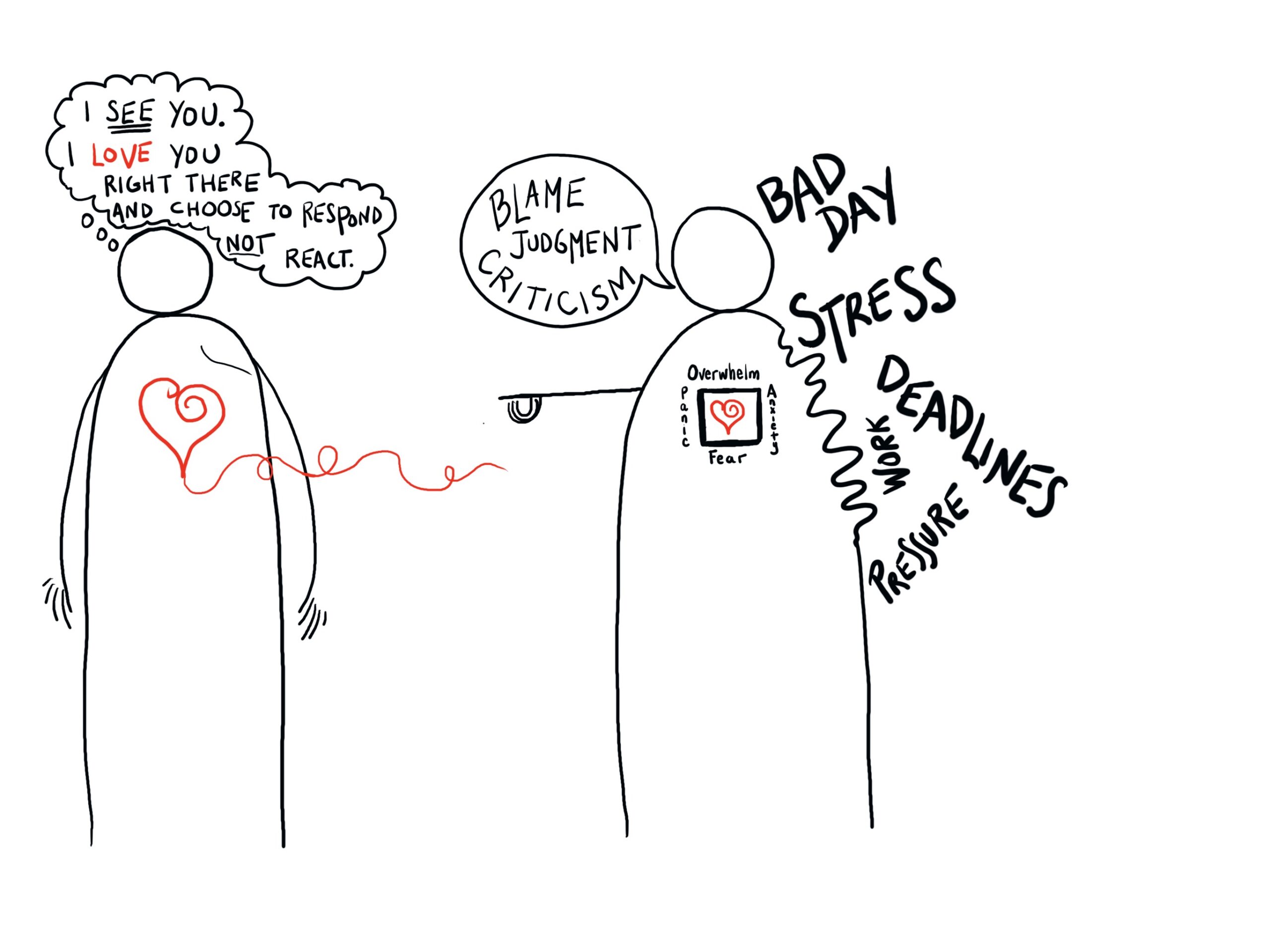
Regulation is about resourcing yourself so that you can remain present with what is happening. It is about creating enough internal safety that you have choices. It is about being able to pause, notice what is occurring in your body, and choose a response rather than simply reacting from an old wound.

This is the first line of action in relationship. We each tasked to take one hundred percent responsibility for our fifty percent of the relational equation.  That includes learning how to manage our nervous system and mindset so that we can show up with greater clarity, integrity, and care.

The Most Regulated Person Leads

This does not mean that you dominate the conversation or become responsible for everyone else’s feelings.  Instead, regulation gives us access to a wider field of possibility.

When we are caught in fear, anger, shame, or overwhelm, our choices narrow. We see threats, become focused on being right, being safe, or making the discomfort stop.

When we are more regulated, we can see more.

We can ask better questions,  recognize that the person in front of us may be struggling too,  hold a boundary without attacking, tell the truth without abandoning ourselves, make room for complexity.

We can lead not by controlling the outcome, but by helping create conditions where a different outcome becomes possible.

This is one of the things I support my clients in developing through specific tools and practices. They learn how to recognize activation before it escalates, calm their biology, interrupt old patterns, and return to themselves in the moments when it matters most.

The goal is not to become an unaffected robot… it’s to become available.  To yourself. To your values. To the relationship you are trying to build.

Co-Regulation and the Sacred Third

Self-regulation is deeply personal. But relationships also invite us into co-regulation: the mutual exchange of calm, safety, and connection between two people.

To be clear, this does not mean one person becomes the other person’s emotional caretaker. It means both people learn how to participate in creating safety together.

In Chapter 20 of my book, Unbreakable Us: Removing the Barriers to Love, I introduce an orientation I call the Sacred Third.

The Sacred Third is the relationship itself.

Not you. Not me. The relationship.

When two people agree to orient toward what benefits the relationship itself, they gain an objective place from which to examine what is happening. Instead of asking, “How do I win?” or “Whose feelings matter more?” they begin asking, “What serves the relationship here?”

This does not erase individual needs. It gives them a more grounded place to be heard.

When we co-agree to honor the Sacred Third, we create an anchor for the moments when life becomes hard. We begin to understand that conflict, difference, disappointment, and adversity do not have to tear us apart. They can become the very places where we learn how to become stronger together.

Tell Me

The next time relational stress appears, pause and ask yourself:

Am I responding from the person I most want to be in this relationship—or from the part of me that is trying to protect itself?

That single question can create enough space to choose a different next step.

Ready to Explore What Is Possible?

If this reflection brought something into focus for you—perhaps a familiar reaction, a recurring relationship pattern, or a place where you long to show up differently—I invite you to schedule a one-to-one Discovery Call with me.

This is a space for us to look beneath what is happening on the surface and explore what may be shaping your experience of connection, conflict, trust, and love. Together, we will identify what may be asking for your attention and consider what a more grounded, resilient path forward could look like.

You do not need to have it all figured out before we speak. You only need to be willing to become curious about what is possible.

[To Schedule Your Discovery Call]

There is much hype on social media about what is needed to REALLY succeed in relationships.  I hear about how overwhelming this is every time I connect with a new potential client for the Your Love by Design Training Programs.

I get it because, one, we are adorably human in our tendency toward complicating things; and two, there’s a lot of relationship quick fix crap out there that is all about providing information without the way to create transformation.  It’s truly unfortunate.

When we are equipped with the knowledge, foundational tools and accountability, we are best able to create long lasting real Love.. by Design. As your Heart Coach, I’m thrilled to share my unique approach with you.

What it takes to create real lasting Love:

  • The phases
    • Preparation
    • Honeymoon
    • Uncertainty
    • Adjustment
    • Commitment
    • Real Love (rinse, rest, repeat)

  • The 7 steps
    • Build your emotional resilience
    • Untangle past patterns from present needs
    • Trust as your new normal
    • Follow the compass of your heart
    • The gift of your devotion
    • Lift the weight of the world off your shoulders
    • Leave a legacy of Love
    • Rinse, rest, repeat

The 4 Phases of Relationship

  • Preparation – being ready and willing to create a genuine connection with another
  • Commitment – being willing to move through the romantic phase into the “I’m in”
  • Recommitment– being willing to remain connected through friction and conflict over and again.
  • Long-lasting Real Love – being willing to consciously being action with the first 3 phases – for a rinse, rest, and repeat.  

These 4 phases are foundational to both navigating the early stages as well as the ongoing growth of your relationship and can be expanded to meet the needs of all your relationships (romantic or otherwise.)

That’s it. 

Our brain will tend toward complicating matters by default which is why it’s always both an inner and outer process when it comes to creating Real Love.  This means it’s about being in process through the 4 phases awhile regulating our nervous system’s reaction to taking the actions needed.

That is why in the Your Love by Design Training Programs we account for 7 stages of relational growth within the phases themselves: each with a deliberately designed curriculum of trainings that teach you the WHAT outer actions to take for each phase so you can continuously bypass fear, doubt, anxiety and  overwhelm and stay committed to the health and development of your relationships long term.

7 steps circle

The 7 Stages of Your Love by Design

When you first enroll into Your Love by Design program, you receive a welcome packet with assessments to help clarify where you are in your relational journey.  Together we review your answers to begin the process of setting intentions and outcomes for your program.

Here is a brief description of each of the Seven Stages of Your Love by Design Program:

Step 1: Build Your Emotional Resilience

First, we must move your nervous system out of its hyper-vigilant fight-flight-freeze-fawn state into a rest-restore-rejuvenate setting.  This is where calm, not anxiety nor fear, becomes your new relational setting.

Step 2: Untangle Past Patterns from Present Need

Overcoming relationship stuckness is NOT about mastering willpower, becoming someone else or settling for less than you deserve.  In this phase of your journey, you develop trust, so you confidently and consistently make choices that are aligned rather than deplete or frustrate you. 

Step 3: Trust as your New Normal

Stop believing and cycling through unhelpful thoughts and relationships get easier, more connected, fulfilling.    No matter what is going on around you, you can trust yourself to handle it with Grace.

Step 4: Follow the Compass of your Heart

From personal experience with healing my own relational wounds and over a decade of research in Relationship Science, I’ve identified that what our minds and our hearts will take us on very distinct paths when it comes to Love.   In our work together, we lead with the heart so you can truly be free from attracting mismatched partners.

lead with the heart so you can truly be free from attracting mismatched partners.

Step 5: The Gift of your Devotion

What you resist, persists. That’s why the pattern of mismatched relationship is a cycle. The way to break this cycle is NOT to resist change. This is where your devotion to setting parameters becomes your greatest advocate and teacher, a wellspring for deep wisdom, a gift from the Universe for your deepest liberation, and a most profound and loving connection.  

Step 6: Lift the Weight of the World from your Shoulders

You have your own Divine Timing when it comes to Love.  This is why together we co-create your own unique approach to dating (if you’re single) or partnership (if you’re coupled) that integrates the upgraded ways of thinking, feeling and being that support you in honoring your own pace with a sense of legitimacy and worth to feel peace.

Step 7: Leave a legacy of Love

With Trust as your new normal, committed to be a stand for Love, friction and conflict are natural occurrences in your relationships.  Redefining those sticky areas between you as new challenges to work on, allows you to take your relationship to the next level, Leaving a Legacy of Love. 

Step 8: Rinse, Rest, Repeat

Just as we bathe regularly to keep healthy hygiene, it’s important to continue and consistently work these steps again and again to keep healthy mental and emotional hygiene in our relationships. It’s not about going back to the beginning or repeating first grade. It’s about moving to your advanced levels of inner trust, so your choices and actions meet the evolving needs of your relationship. This is the path to mastery. 

A Unique element to the programs

Aside from considering the 4 phases of relationship and the 7 stages for creating Your Love by Design, one of the most unique components I’ve weaved into your program is brain-based, intuitive, creative processes that require no artistic ability.

In my decades long studies in Expressive Arts and Intentional Creativity, I’ve learned the value of using creativity to unleash the power of the unconscious into conscious insight and action, learning how to direct its relational power to really work FOR you rather than against you. It changes your life.

The trainings in your program include creative processes that change EVERYTHING about how you be, do and relate, everything.

These are just a few of the powerful processes we have in the program:

  • SoulCollage
  • Polarity Squares
  • Orphan Rescue process
  • Future Self Visioning process
  • …and much more

The Way Forward

When you learn to apply these specifically tailored to you coaching and accountability and practical trainings with creativity, you’ll find your relational trust and confidence grow. And, seriously will not believe what starts to show up “out of the blue” (a partner, if you’re single; more intimacy and connection if you’re coupled). I’ve seen it so many times, I’ve stopped counting.

No matter where you are in your relationship phase, and no matter what you are looking to create – suddenly it begins to come to fruition with so you find yourself doing less, receiving more and achieving a greater impact in all your relationships.

If you sense Your Love by Design is a fit for you, CLICK HERE now so we can chat about what this is meant to be for you.

I so look forward to you experiencing the kind of Love you could never imagine.

May Love be your decision today, always, and in all ways,

Joëlle