
I used to think conflict meant the end of a relationship.
Not eventually. Immediately.
Something would shift between me and the person I loved—a disagreement, a disappointment, a tone of voice, a silence—and my whole system would light up.
- Fix it.
- Reconnect.
- Make it okay.
- Find the words.
- Do something.
To my nervous system, it felt as if the relationship were slipping through my fingers and, if I didn’t catch it quickly enough, it would be gone. Conflict was not experienced as two people having a hard conversation but as danger.
Relationships were an enigma to me.
I watched others navigate them with what seemed like such ease – loving each other, disagreeing, getting annoyed, then finding their way back. A language everyone else seems to know.
My experience felt like a veil obscuring the world of connection that I couldn’t quite penetrate. And although I could see what was happening on the other side, I just couldn’t seem to find my way in.
Tenuous at best.
It took a contentious divorce and a long-term relationship to understand that conflict wasn’t necessarily telling me that a relationship was ending.
But there was another story I had to confront, too.
I had been a loyal, card-carrying member of the Men Are Pigs Club.
And honestly, I had reasons. My lived experience had given me plenty of evidence for the stories about men I was carrying.
Then, I participated in an event that brought women and men together to have unusually honest conversations about the nature of relationship, masculinity, power, vulnerability and what it meant to not only see one another, but to have one another’s back.
I had arrived into that room carrying a boatload of assumptions with me. Unable to trust , I wasn’t particularly interested in having my mind changed. And yet.
As I listened, encountering men as individuals rather than a category – complicated, tender, defensive, funny, courageous, wounded, afraid, human – something began to loosen as a singular question arose in me.
What if….?
- What if what i was hearing was the truth about men?
- what if what I believed about them all this time was false?
Sitting in this question did not make my previous experience wrong. Instead, it opened me up to a broader story I began to notice what happens when we meet a person instead of the story we’ve already told ourselves about them.
It set me off on creating a yearlong journey of dating men for the exclusive purpose of changing my mind about them (…you can read all about this in my book Unbreakable Us: Removing the Barriers to Love.)
To be in relationship with them, I needed to discover that my assumptions were not the whole story.
Because I see the same thing happen in relationships all the time. We think we’re having a disagreement about what happened yesterday. More often than not, we’re also meeting the story we carry about each other.
- You always do this.
- You never listen.
- You don’t care.
- I can’t trust you.
- Here we go again.
And once that story takes over, the person in front of us can almost disappear and we find ourselves no longer responding only to what is happening. We’re responding to what we believe is happening.
(Believe me, I’ve done this.)
And I know how quickly me versus you can take over: You hurt me. You don’t understand me. I’m right. You’re wrong. If you would just see it my way…
And suddenly we’re no longer two people trying to understand something together but two people defending our corners.
My needs. Your needs.
My truth. Your truth.
My wound. Your wound.
A border goes up. I’m over here. You’re over there.
And now somebody has to win, or give in, or be wrong.
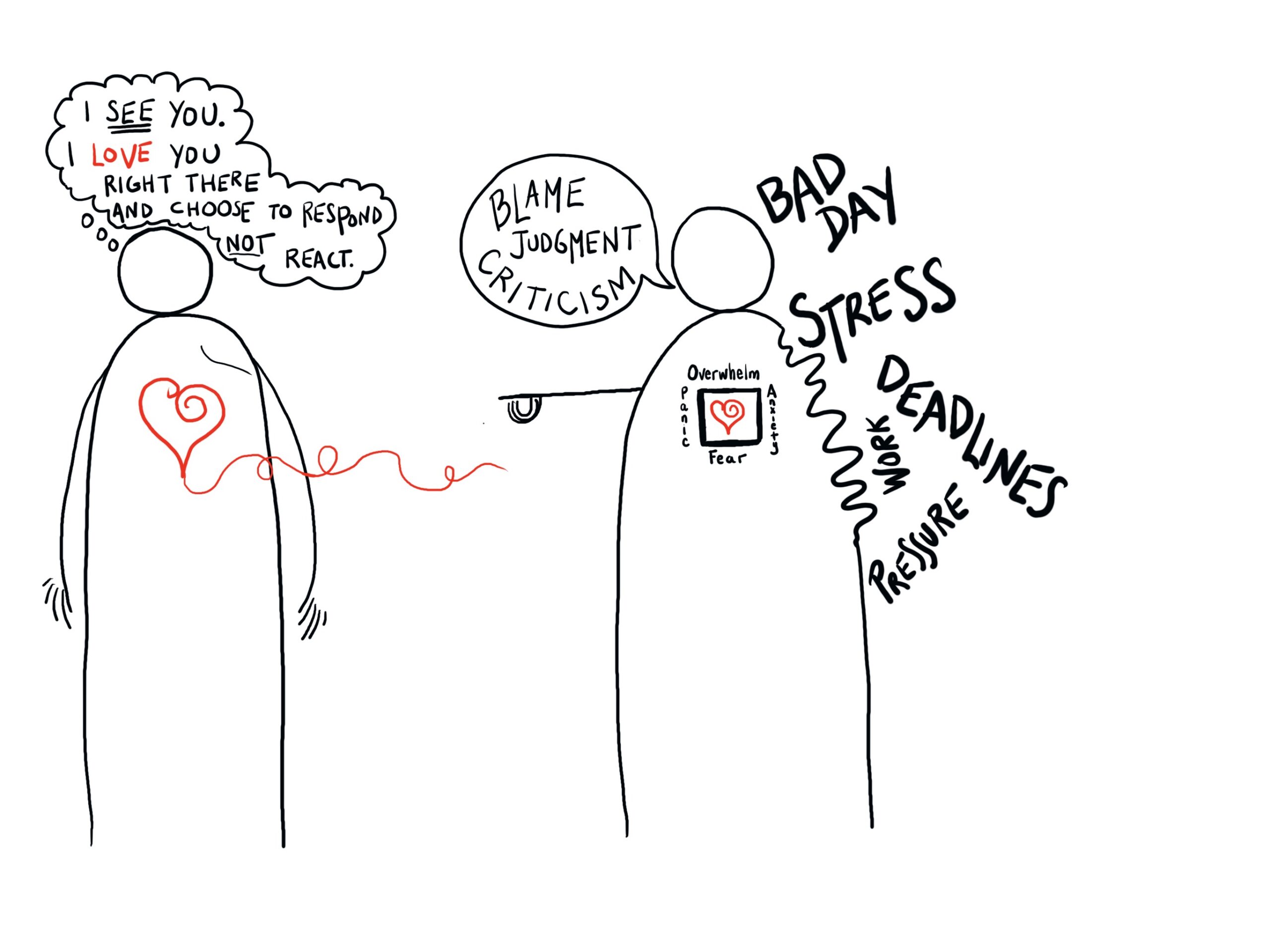
What has become increasingly interesting to me is what happens when I notice that border starts to go up. Stopping long enough to wonder what I’m bringing to this moment?
Can I be curious and allow the possibility that what I think I know isn’t the whole story?
That doesn’t mean abandoning discernment, ignoring misbehavior or staying in harms way.
It simply means leaving a little room for reality. Because reality is often more complicated than the story. And sometimes, much more beautiful.
This is where the idea of the Sacred Third has become so meaningful – recognizing the “me,” the “you,” and the “us” of the relationship we are co-creating together.
When caught in the binary perspective of me versus you, one becomes very focused on protecting a position. On being understood. On proving a point. On making sure my experience isn’t erased.
But when I can remember the us, another possibility opens that goes beyond agreement or coercion. Curiosity. Sitting in questions such as:
- What is happening between us?
- What are we creating here?
- What might become possible if neither of us has to be the enemy?
I don’t have an easy answer. In fact, I don’t think there is one.
I’ve spent enough years doing this work, to know that relationship isn’t a problem we solve once and then graduate from.
I sit with people who love deeply and still can’t seem to find their way through the same pattern or argument. People who have become so practiced at protecting themselves that they can barely feel what they actually want. Ones who are exhausted from trying to be understood.
And, rather than provide answers, I ask questions. We get curious about what is underneath the pattern, the argument. Slow down enough to notice the story. Make room for what each person knows—and what might still be in the mystery.
Sometimes that changes everything. Sometimes it simply changes the next conversation.
And sometimes the most important thing that happens is that someone realizes they have been meeting the person in front of them through the lens of an old story.
(I know something about that.)
I used to think men were the problem, conflict was the problem, or the distance between me and connection was something I needed to somehow force my way through.
Now I wonder if the threshold is something else entirely.
Perhaps it is the place where the story we’ve been living inside meets something real enough to challenge it. Where we have agency and choice.
- Do I retreat into what I already know? Do I make you the problem? Do I make myself wrong?
- Or
- can I stay here for another moment? Can I get curious? Can I meet what is actually here?
To be clear, conflict doesn’t just disappear, but it’s also not the end of a conversation. Instead it’s the beginning of a different one.
A conversation neither of us could have had before we arrived at this particular threshold.
Perhaps that’s what makes relationship so endlessly interesting to me now. (Not that I’ve figured it all out – and know I don’t have to.)
There is always something more to discover.
About you.
About me.
About the space between us.
And about the us we might create when we’re willing to meet there.
What if conflict isn’t the opposite of connection? What if sometimes, it’s the threshold?
Ready to Explore What Is Possible?
If this reflection brought something into focus for you—perhaps a familiar reaction, a recurring relationship pattern, or a place where you long to show up differently—I invite you to Meet me at the Threshold starting September 29th.
It’s a 5 week relationship exploration where we investigate where your next steps. 1-1 call with me and conversation with a panel of men is included in this one of a kind experience.
You do not need to have it all figured out. You only need to be willing to become curious about what is possible.