518-727-5458 joelle@joellelydon.com

Why self-regulation is one of the most important relationship skills you can build

Years ago, I watched My Big Fat Greek Wedding—a film I have returned to many times since. There is a line in it that has stayed with me, one I often share with clients.

When Toula is struggling with her father, her mother Maria offers this bit of wisdom: “The man is the head, but the woman is the neck. And she can turn the head any way she wants.”

At the time, I took it as the funny, culturally loaded line it was meant to be. But over the years, I have come to hear something else in it.   Not that one person should control another, but that, in a relationship, the person who can see the clearest path forward often has the greatest ability to influence what happens next.

And in my experience, that clarity is rarely about who is smarter, more persuasive, or more “right.”  It is more about who is most regulated.

Being regulated means you have greater access to perspective. That you can often see beyond the immediate hurt, fear, anger, or misunderstanding. That you are more able to pause before reacting, to stay connected to yourself, and to remember what matters most.

This does not make you superior. Nor does it mean you carry the entire relationship. It simply means you may be the person with enough internal steadiness, in that moment, to help create a different path forward.

That is why I believe your nervous system is in the relationship too.

There is you. There is the other person. And there are the nervous systems both of you bring into every conversation, disagreement, disappointment, rupture, repair, and moment of connection.

The Part of You That’s Always Listening

Everywhere we look, there’s a great deal of conversation today about nervous system regulation. And for good reason. Yet it can sometimes feel overly scientific, overly clinical, or disconnected from the ordinary moments where relationships actually unfold.

At its most basic, your nervous system is your body’s command center and communication network. It is constantly taking in information from the world around you and from within you. It helps determine whether you feel safe, threatened, connected, overwhelmed, calm, alert, shut down, or ready to act.

It influences your breathing, your sleep, your memory, your capacity to focus, and your emotional responses. It is always listening for cues: the tone in someone’s voice, the pause before they respond, the look on their face, the text that goes unanswered, the familiar feeling that tells you something is wrong.

And when it perceives threat, it moves quickly before you have had time to think.

That is why you can know you do not want to react in a certain way and still find yourself reacting. You can understand that a conversation is not really about the dishes, the vacation, the money, or the missed phone call—and still feel yourself becoming defensive, shutting down, over-explaining, criticizing, or trying desperately to make the discomfort stop.

The good news is that your nervous system is adaptive.

You are not trapped by the baseline you were born with or the patterns you learned in earlier relationships. You are not destined to repeat the same reactions for the rest of your life. Your nervous system can learn new ways of responding. It can become more resilient, develop greater capacity for staying present when life becomes difficult.

And that changes everything.

When Protection Takes Over

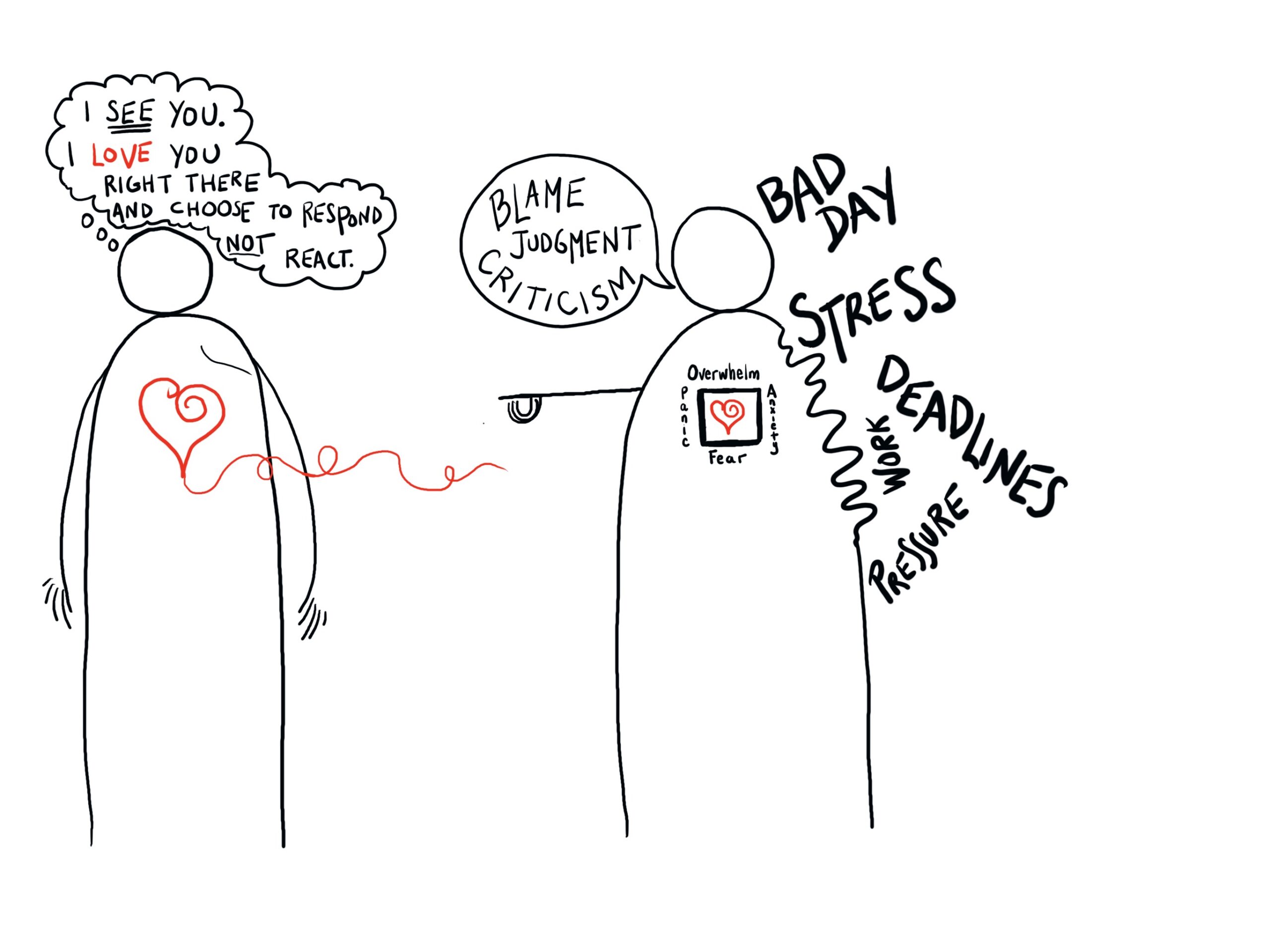
Most people do not recognize dysregulation when it is happening. They simply think, “This is how I feel,” or “This is what they made me do.”

But dysregulation can look very familiar. It can look like:

  • emotions that go from zero to one hundred in a matter of seconds.
  • replaying a conversation in your mind long after it is over,
  • trying to find the moment where everything went wrong.
  • making a decision quickly because sitting with uncertainty feels unbearable.
  • withdrawing from someone you love because closeness suddenly feels too vulnerable.
  • becoming intensely focused on getting reassurance, agreement, or resolution right now.
  • losing trust in yourself because your feelings feel so large that you no longer know which part of you to believe.

In relationships, dysregulation may show up as explosive reactions, emotional distance, silent treatment, criticism, defensiveness, blame, people-pleasing, or the exhausting experience of walking on eggshells around one another.

Many people assume these are communication problems.

Often, they are nervous system problems first.

This does not excuse harmful behavior. We are still responsible for how we treat one another. But it does help us understand why good intentions can disappear so quickly when we feel threatened.

When the nervous system is activated, we are often no longer operating from our deepest values. We are operating from protection.

Why Knowing Better Is Not Always Enough

One of the most common things I hear from clients is, “I know better, but I still do the same thing.”

That sentence holds so much tenderness.

Because it is not usually a lack of intelligence, awareness, or desire that keeps someone repeating an old pattern. Most people already know what they wish they could do differently. They have read the books. They have listened to the podcasts. They have had the conversations with friends. They may even have been in therapy or coaching before.

And yet, when the charged moment arrives, the old response takes over.

There are often several layers involved.

The first is the nervous system. When something in a relationship feels threatening—criticism, withdrawal, conflict, disappointment, rejection, or uncertainty—the body responds before the thinking mind has a chance to catch up.

The second is attachment learning. Most of us absorbed powerful messages about love early in life. We learned whether love was stable or unpredictable, freely given or something we had to earn, safe or something that could be withdrawn without warning. Those experiences become internal maps. And when relationships become emotionally intense, we often follow the map we learned long ago, even when it no longer serves us.

The third layer is what I call old agreements. These are quiet promises we made somewhere along the way: “Keep the peace.” “Do not need too much.” “Take care of everyone else first.” “If I tell the truth, I will lose love.” “If I am perfect, maybe I will be safe.” These agreements can operate beneath conscious awareness for decades.

So when someone says, “I know better, but I still do the same thing,” what they are often noticing is that their thinking mind has updated, but their body and relational habits have not caught up yet.

Growing Down: Regulation as an Act of Responsibility

In my practice and in my book Unbreakable Us: Removing the Barriers to Love, this is part of what I call Growing Down work.

We spend much of our lives learning how to grow up:  gaining knowledge, building careers, developing skills, and become increasingly capable in the world. Yet many of us discover that emotional maturity asks something different of us.

Becoming more intimate with the parts of ourselves that learned to protect us.

Growing Down is not about becoming less capable. It is about returning to the places where our patterns began and developing the capacity to care for ourselves there, rather than asking our partners, children, friends, or colleagues to manage what we have not yet learned to hold.

This is why the first thing I teach is regulation as an act of personal and energetic responsibility.

Regulation is about resourcing yourself so that you can remain present with what is happening. It is about creating enough internal safety that you have choices. It is about being able to pause, notice what is occurring in your body, and choose a response rather than simply reacting from an old wound.

This is the first line of action in relationship. We each tasked to take one hundred percent responsibility for our fifty percent of the relational equation.  That includes learning how to manage our nervous system and mindset so that we can show up with greater clarity, integrity, and care.

The Most Regulated Person Leads

This does not mean that you dominate the conversation or become responsible for everyone else’s feelings.  Instead, regulation gives us access to a wider field of possibility.

When we are caught in fear, anger, shame, or overwhelm, our choices narrow. We see threats, become focused on being right, being safe, or making the discomfort stop.

When we are more regulated, we can see more.

We can ask better questions,  recognize that the person in front of us may be struggling too,  hold a boundary without attacking, tell the truth without abandoning ourselves, make room for complexity.

We can lead not by controlling the outcome, but by helping create conditions where a different outcome becomes possible.

This is one of the things I support my clients in developing through specific tools and practices. They learn how to recognize activation before it escalates, calm their biology, interrupt old patterns, and return to themselves in the moments when it matters most.

The goal is not to become an unaffected robot… it’s to become available.  To yourself. To your values. To the relationship you are trying to build.

Co-Regulation and the Sacred Third

Self-regulation is deeply personal. But relationships also invite us into co-regulation: the mutual exchange of calm, safety, and connection between two people.

To be clear, this does not mean one person becomes the other person’s emotional caretaker. It means both people learn how to participate in creating safety together.

In Chapter 20 of my book, Unbreakable Us: Removing the Barriers to Love, I introduce an orientation I call the Sacred Third.

The Sacred Third is the relationship itself.

Not you. Not me. The relationship.

When two people agree to orient toward what benefits the relationship itself, they gain an objective place from which to examine what is happening. Instead of asking, “How do I win?” or “Whose feelings matter more?” they begin asking, “What serves the relationship here?”

This does not erase individual needs. It gives them a more grounded place to be heard.

When we co-agree to honor the Sacred Third, we create an anchor for the moments when life becomes hard. We begin to understand that conflict, difference, disappointment, and adversity do not have to tear us apart. They can become the very places where we learn how to become stronger together.

Tell Me

The next time relational stress appears, pause and ask yourself:

Am I responding from the person I most want to be in this relationship—or from the part of me that is trying to protect itself?

That single question can create enough space to choose a different next step.

Ready to Explore What Is Possible?

If this reflection brought something into focus for you—perhaps a familiar reaction, a recurring relationship pattern, or a place where you long to show up differently—I invite you to schedule a one-to-one Discovery Call with me.

This is a space for us to look beneath what is happening on the surface and explore what may be shaping your experience of connection, conflict, trust, and love. Together, we will identify what may be asking for your attention and consider what a more grounded, resilient path forward could look like.

You do not need to have it all figured out before we speak. You only need to be willing to become curious about what is possible.

[To Schedule Your Discovery Call]

In the words of Rumi,

“Your task is not to seek for love but merely to seek and find all the barriers within yourself that you have built against it.”

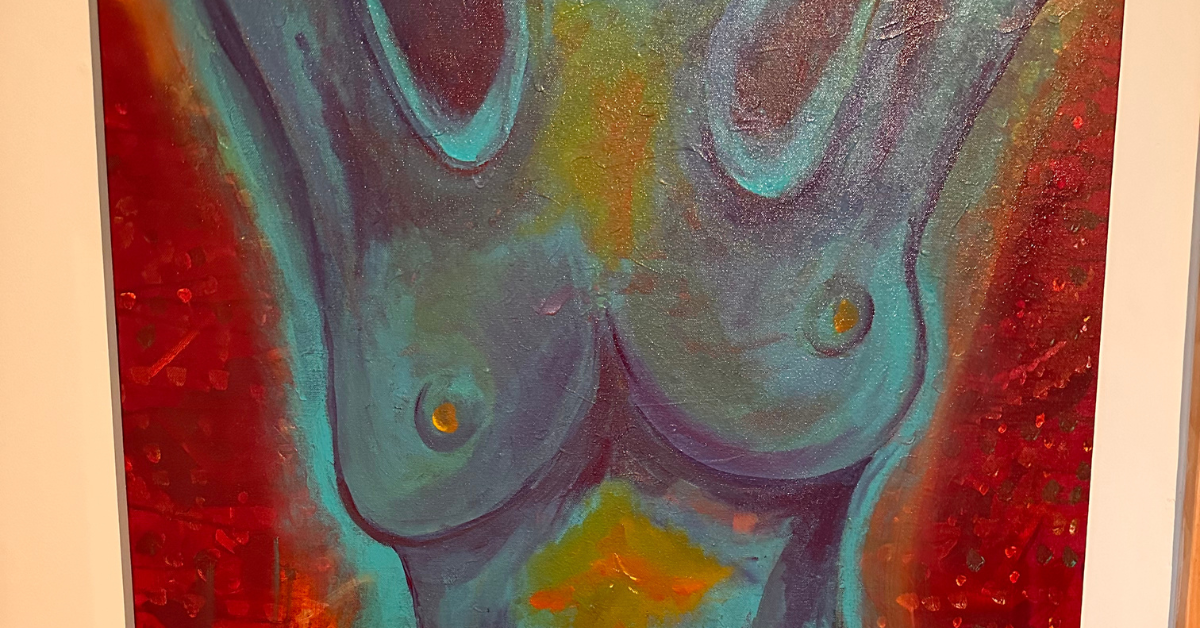
Recently, I embarked on a truly unique journey with a client. It was a departure from my usual coaching approach that spanned five transformative weeks. What set this particular journey apart was our decision to work in person, face-to-face, and the profound role that art and canvas played in our process.

As we immersed ourselves in this creative and introspective journey, we went beyond the conventional coaching techniques. We infused our intentions directly into the canvas, creating a tangible and evolving representation of our work together. Each brushstroke became a symbol of introspection, a layer of self-awareness, and a channel for the free flow of emotions.

It was during these artistic endeavors that my client began to courageously dismantle the invisible barriers she had spent years constructing around her heart. This process pushed her to the limits of her own longing. She welcomed, in the words of Rainer Maria Rilke, both the “beauty and terror” of her emotions to the banquet table of her self-discovery. In this space, she learned to trust that every aspect of her experience held value and intelligence. We incorporated it all into the canvas. This included not only her own burdens but also those she had carried on behalf of others.

“Not mine. Not mine. Not mine.”

Informed by her past but no longer defined by it, she bravely shed these burdens with every layer of paint added to the canvas. Each stroke was a symbol of release, a return to sender for what did not truly belong to her. In this process, we uncovered a deep wellspring of self-love and authenticity within her that had been obscured for far too long.

In the “beauty and terror” of our life experiences, there exists an innate wisdom. When we allow these emotions to surface, giving them the space they deserve, we find ourselves standing in our relationships more fully embodied and authentic.

Today, my client has a canvas hanging proudly in her home. It’s a testament to the transformative work she undertook during our journey together. It serves as a reminder that creativity is a powerful tool for releasing what’s not truly ours to keep. It allows our inner self-intimacy to shine forth in all its brilliance. 

How can you harness the power of creativity to release what’s not yours to keep, allowing your inner self-intimacy to alight?

I signed up to work with joelle because I wanted to do a deep dive into accepting my body. I have had a long history with my body from feeling too heavy to unwelcomed attention. 

Joelle has mastered the art of creating a sacred space and holding it with love and focused intuition. 

She opened each session with a beautiful centering and each approach to the canvass was thoughtful and energetic allowing the process to be deep and creative at the same time. 

Joelle knows when to help with artistic suggestions and when to hold back and let the creativity flow. 

I felt so held and guided and the whole experience was deeply transformative, rich and fun at the same time. I highly recommend joelle and this exploration.”

~ Jasmine


Let’s talk. Click here now to apply for your complimentary Discovery Call with me. Let’s see if the relationship work I do is a match for what you’re looking for.