
Years ago, I watched the movie, “My Big Fat Greek Wedding” and laughed at a line that has stuck with me. It happens when the main character, Toula, is struggling with her father, and her mother, Maria, offers this bit of wisdom:
“The man is the head, but the woman is the neck. And she can turn the head any way she wants.”
At the time, I thought it was funny. Years later, I hear something entirely different.
What strikes me now is that the person who can see the clearest path forward often becomes the one who influences the direction of the relationship. Neither through force or manipulation. Rather through presence.
Over the years, coaching individuals and couples, I’ve come to believe that the person who is most regulated is often the person best positioned to lead. Why? They have access to resources and perspective when others do not.
And that brings me to something I wish more people understood:
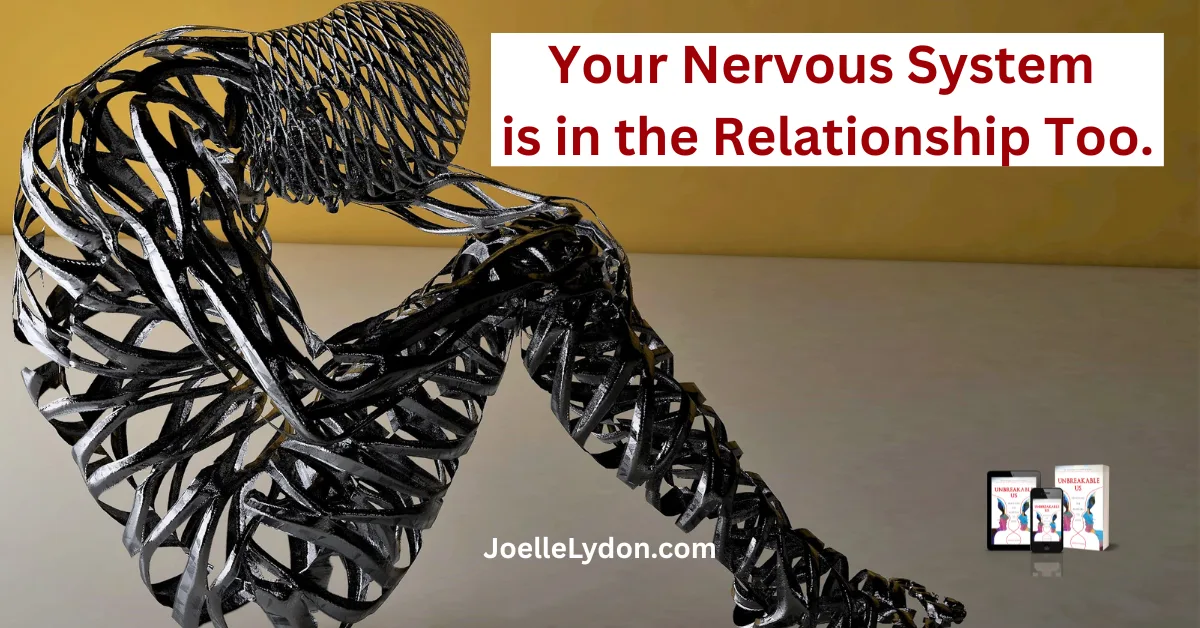
Your nervous system is in the relationship too.
When most people think about improving their relationships, they focus on communication skills, boundaries, conflict resolution, or finding the “right” partner. While those things matter, they often overlook the silent force influencing every interaction they have.
Without getting overly scientific, your nervous system is your body’s communication network. It is constantly gathering information, assessing safety, and determining how you respond to the world around you. It influences what you think, feel, perceive, remember, and do.
The beautiful thing is that it is adaptive.
You are not trapped by the baseline you inherited. You are not condemned to repeat the same emotional reactions, relationship patterns, or coping strategies forever.
Your nervous system can learn. It can become more resilient. It can develop greater capacity. And that matters because relationships will inevitably ask things of us that challenge our capacity.
Disappointment. Conflict. Misunderstanding. Distance. Loss. Uncertainty. The question isn’t whether these experiences will occur. The question is who we be when they do.
Over the last 15 years in my practice, I’ve been teaching the foundational tools of nervous system regulation as an act of personal responsibility. Way before it was trendy or the latest self-development buzzword.
Regulation directly impacts our ability to remain connected to ourselves and others during difficult moments – our ability to honor our integrity and values.
This is what I refer to as the skill of “Growing Down” with my clients, the first line of work we do together.
Many people spend years educating themselves. They acquire knowledge, build careers, develop competencies, and gather life experience. Yet when they enter emotionally charged situations, they discover that insight alone isn’t enough. They “know” better, but when push comes to shove, still do the same thing, experience the same kind of outcome.
Perhaps you’ve experienced this yourself.
- Telling yourself you won’t send the text then sending it.
- Promising yourself you’ll stay calm, then reacting inappropriately
- Knowing the conversation isn’t really about what was said, but you find yourself defending, withdrawing, criticizing, or shutting down anyway.
If you’ve ever found yourself saying, “I know better, but I still do the same thing,” you’re describing the gap between awareness and embodiment. Your nervous system is part of it.
When something in a relationship feels threatening—criticism, rejection, conflict, disappointment, distance—the body reacts before the thinking mind has a chance to weigh in. Suddenly, you’re no longer operating from your values. You’re operating from protection.
Most of us also carry attachment lessons from earlier experiences. We learned whether love felt stable or unpredictable. Whether our needs were welcomed or inconvenient. Whether we needed to earn affection or prove our worth. Those experiences become internal maps.
Then there are what I call old agreements—the quiet promises we made somewhere along the way.
- “Keep the peace.”
- “Don’t be too much.”
- “Don’t ask for what you need.”
- “Take care of everyone else first.”
- “Avoid conflict at all costs.”
Many of these agreements operate beneath conscious awareness for decades.
So when a relationship becomes challenging, it isn’t simply today’s circumstances influencing our response. The nervous system, old attachment patterns, and long-held agreements may all be participating in the conversation.
This is why dysregulation can show up in ways that surprise us.
It may look like emotions that move from zero to one hundred in seconds or like replaying conversations for hours, like making impulsive decisions simply to stop feeling uncomfortable, or like withdrawing from someone you care deeply about because closeness suddenly feels unsafe.
Within relationships, it can create misunderstandings, emotional volatility, defensiveness, blame, criticism, silent treatment, or the exhausting feeling of walking on eggshells.
Most people assume these are communication problems.
They are actually nervous system problems. Which is why regulation becomes such an important relational skill. When we learn how to calm our biology, return to center, and stay connected to ourselves during activation, we gain access to choice.
- We become less reactive.
- More intentional.
- More capable of responding from our values rather than our fears.
This doesn’t mean we never get upset or even perfectly calm. It means we develop the ability to return to ourselves more quickly when life pulls us away. And in my experience, the person who can do that becomes a stabilizing force within the relationship. The one who can see beyond the immediate storm, access possibility when others can only see the problem and help create a path forward.
This naturally leads to another important concept I teach called co-regulation.
While self-regulation is an individual practice, co-regulation is relational. It’s the mutual exchange of safety that occurs between two people. The ability to help one another return to center, remember that you are not enemies and to reconnect with what matters most.
In my book, Unbreakable Us: Removing the Barriers to Love, I introduce a concept I call the Sacred Third – which is the relationship itself.
Not you.
Not me.
The relationship.
When two people orient toward what benefits the relationship itself, they gain access to a perspective larger than their individual emotions in the moment. Instead of asking, “How do I win?” they begin asking, “What serves the relationship?”
That shift changes everything.
Difficult moments stop becoming threats to the relationship and start becoming opportunities to strengthen it. The relationship becomes an anchor during adversity rather than another casualty of it.
Which brings me back to Maria’s wisdom….
Perhaps the neck isn’t the woman. Perhaps the neck is whoever can access enough regulation to see beyond the immediate challenge. Whoever can stay connected to themselves while remaining connected to another. Whoever can remember what matters most when emotions are running high.
That kind of leadership isn’t about control. It’s about responsibility. And it may be one of the greatest gifts we can offer the people we love.
Tell me
How do you prioritize your nervous system self care as an act of personal responsibility toward your relationships?
Your Next Step
If this article resonates and you’re curious about what may be operating beneath the surface of your own relationship patterns, I invite you to apply for your complimentary conversation.
Together we’ll explore where you may be getting pulled away from the relationships you most desire, what your nervous system may be trying to protect, and what it might look like to cultivate greater trust, resilience, and connection moving forward.
Sometimes one conversation is enough to reveal a completely different path forward.
I’m Joëlle Lydon — relationship coach, artist, author of Unbreakable Us, and guide to those ready to remove the barriers to love.
My mission is to reimagine relationship from an unconscious pattern we repeat to a conscious partnership we create. Where ease, trust, and peace are not goals to strive for— but natural outcomes of how we show up for one another.
- Follow along here for insights on courageous love: https://lnkd.in/euSpu7fY
- Subscribe to my weekly Love Notes — direct, clear, and designed to strengthen your relational foundation
- Reach out to book a private conversation if you’re ready for deeper work
- Purchase a copy of Unbreakable Us: Removing the Barriers to Love