
“Boundaries are the litmus test for the quality of our relationships.” — Dr. Henry Cloud
I remember the first time my ex-husband said “no” to me. Even now, I can feel it in my body. My breath shortened. My throat tightened. My chest constricted. My face flushed.
I wasn’t just surprised—I was undone.
His “no” didn’t land as information. It landed as rejection. As a rupture. As something wrong.
Because somewhere along the way, I had learned a quiet, unquestioned rule about love:
If we care about each other, the answer is yes.
- Yes to the request.
- Yes to the inconvenience.
- Yes even when it costs us something.
Isn’t that what it means to be a good partner? To be loving? To be committed?
So when he said no, it didn’t just challenge a moment—it shattered an entire internal system.
At first, I made it mean something about me.
Over time, I swung the other way: If he can say no, so can I.
But that version of “boundaries” wasn’t clean—it was reactive.
It came out sideways: controlling, punishing, keeping score.
Later, I refined it (or so I thought): I could say no… but only if I explained it. Fully. Thoroughly. A simple boundary became a dissertation—justifying, defending, making sure the other person understood why.
It took years—decades, really—and a different relationship for something to finally settle.
Now, a boundary can sound like this:
“No.”
And it’s not loaded. Not defensive. Not explained into exhaustion. Just clear. Grounded. Intact.
If this is hard for you, you’re not alone. There is a real growth curve here. And it matters more than most people realize—because boundaries aren’t about distance. They’re about relationship hygiene.
The Myths That Keep You Stuck
There’s a lot of confusion around boundaries, and most of it comes from what we’ve been taught—explicitly or implicitly.
Boundaries are not:
- Selfish, rude, or unkind
- A way to control or restrict others
- Something that pushes people away
What actually pushes people away is something else entirely: giving without limit… until resentment builds… and something sharp or explosive replaces the connection.
Boundaries are also not one-size-fits-all. They’re not designed to limit your joy. And they’re certainly not meant to make relationships harder. But if you’ve been operating without them—or with inconsistent ones—they can feel that way at first.
What Boundaries Actually Are
At their core, boundaries create clarity.
What’s okay.
What’s not okay.
What’s mine to carry.
What isn’t.
They are not rules for other people—they are guidelines for your own behavior. They allow you to stay connected without abandoning yourself.
In my book Unbreakable Us, I describe this as your piece of the “red thread”—the part of the relationship that belongs to you. You are responsible for your choices, your values, your actions. You are not responsible for someone else’s reaction to them.
That distinction changes everything.
Because without it, we start managing other people’s emotions at the expense of our own integrity.
The Simplicity (and Difficulty) of Boundaries
Boundary-setting isn’t complicated—but it isn’t easy either.
It comes down to three things:
- Deciding what you will and won’t take responsibility for
- Communicating that clearly
- Following through consistently
That’s it.
And also… that’s everything. Because most breakdowns don’t happen in the decision. They happen in the follow-through.
Why Boundaries Break Down
Most people don’t struggle with boundaries because they don’t value them.They struggle because they blur the line between a boundary and a request.
For example:
“It would really help me if you didn’t call so late.”
That’s a preference. Maybe even a wish or a hope.
Compare that to:
“I’m not available for calls after 9pm.”
Now we’re in boundary territory.
The first relies on the other person changing. The second clarifies what you will do. And that’s the shift: Boundaries don’t require agreement—they require clarity and consistency.
The Guilt That Comes With It
If you’ve been someone who over-gives, over-accommodates, or over-functions in relationships, boundaries will feel uncomfortable at first. Not because they’re wrong. But because they’re new.
You may feel guilt.
You may question yourself.
You may feel like you’re letting someone down.
What’s actually happening is that the system you’ve been participating in is changing. And if others have benefited from your lack of boundaries, your clarity may feel disruptive to them.
That doesn’t make it a mistake. Discomfort is not a reliable indicator that you’ve done something wrong.
When a Boundary Is Crossed
Here’s the part many people miss: If a boundary is crossed and you say nothing, it doesn’t stay a boundary—it becomes a silent expectation.
Repair is your responsibility. (remember that “red thread?”)
Not from a place of blame, but from a place of clarity.
- Name what happened
- Reaffirm the boundary
- Follow through
This is how trust is built—not just with others, but within yourself.
The Gift I Didn’t Recognize at the Time
Looking back, that “no” from my ex-husband was a turning point although it didn’t feel like one then. It felt jarring, even painful. But it introduced me to something I had never truly understood:
Love without boundaries isn’t love—it’s entanglement.
As Brené Brown says, the most compassionate people are also the most boundaried. Not because they care less. But because they’ve learned how to care without losing themselves.
And that’s the work.
Not building walls. Not shutting people out. But learning how to stay—fully, honestly, and cleanly— in relationship with others and with yourself.
So tell me:
Where in your life are you saying “yes” when something in you is asking for a “no”?
Where are you taking responsibility for something that isn’t actually yours?
And what might shift if you trusted yourself enough to be clear—without over-explaining?
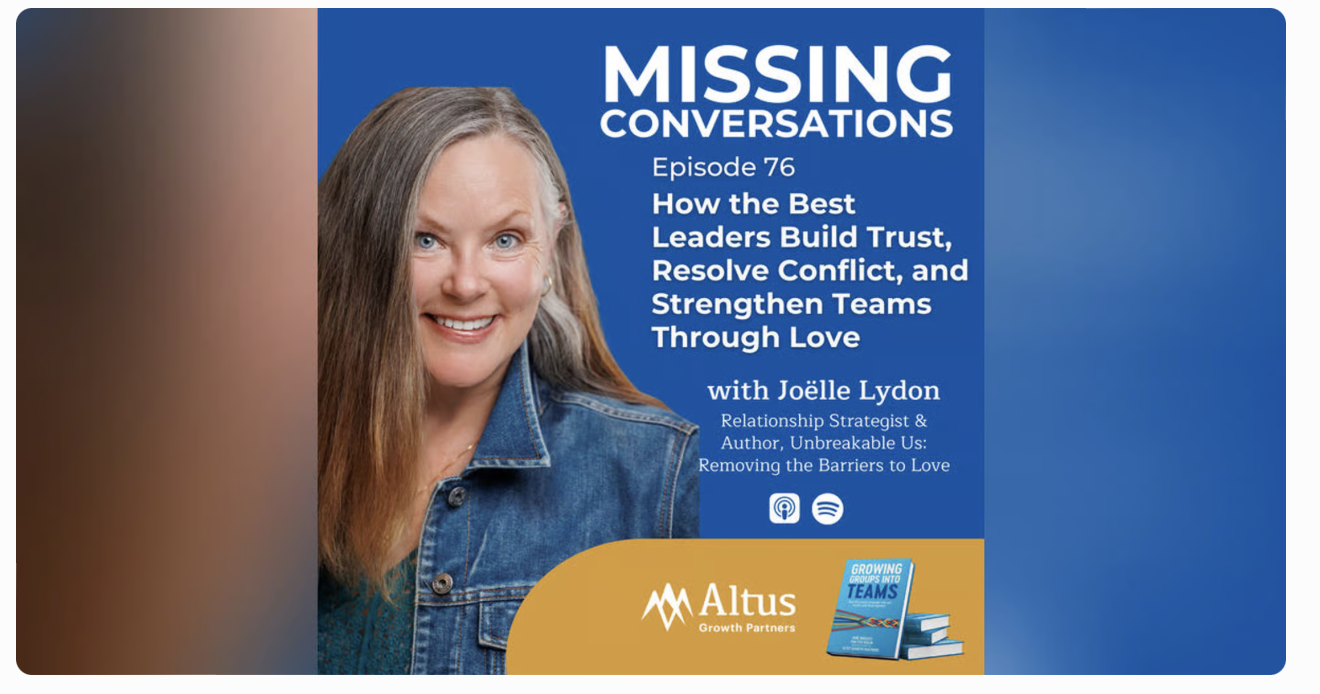
I’m Joëlle Lydon — relationship coach, author of Unbreakable Us, and guide to those ready to remove the barriers to love.
My mission is to reimagine relationship from an unconscious pattern we repeat to a conscious partnership we create. Where ease, trust, and peace are not goals to strive for— but natural outcomes of how we show up for one another. I invite you into the relationship that’s waiting for you.